









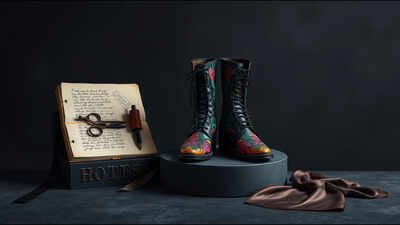
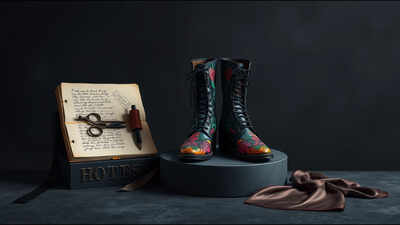
A portfolio Martin Margiela created in 1987 while developing the idea for his future fashion house was stolen on a train and recovered by police a year later. Nearly four decades later, the portfolio was offered at auction in Paris in July, as part of a sale drawn from Margiela’s personal archives. Described by Maurice Auction as the first portfolio illustrating the future Maison Martin Margiela, the 1987 dossier contains 13 A3-format pages of drawings, facsimiles and collages setting out the aesthetic of the then-unnamed house. Estimated at €5,000 to €8,000, it sold for €24,700 at the July 9, 2026 sale, including fees. The archive sale also brought together sketches, prototypes, garments and personal objects spanning Margiela’s career and later years at Hermès.
Martin Margiela’s 1987 portfolio captured the idea behind his future fashion house
The portfolio dates to the period before Maison Martin Margiela was established in 1988. In his note accompanying the auction lot, Margiela recalled that he was looking for a manufacturer in Italy and needed to visualise the fashion he wanted to create. He drew silhouettes and accessories for his imagined fashion house and assembled them in a white cotton-covered folder. Maurice Auction describes the resulting dossier as the first portfolio illustrating the future Maison Martin Margiela and says its 13 A3-format pages of drawings, facsimiles and collages set out the house’s aesthetic.The folder was later stolen on a train. Margiela made another version for his travels, using photocopies of the drawings. He recalled that he considered the photocopies more contemporary than the original pencil sketches and was able to create an almost identical portfolio. A year later, police recovered the stolen folder, after which Margiela compared the two versions and was struck by their similarity. The auction catalogue gives the provenance of the portfolio offered for sale as Margiela’s personal archives, but does not specify whether the lot was the recovered original or the replacement.
The archive sale traced Margiela’s career from 1984 onwards
The 1987 portfolio was part of a wider sale of Margiela’s personal archives organised by Maurice Auction in collaboration with Kerry Taylor Auctions. The auction house said the material covered the period from 1984 to 2008 and included photographs, drawings and objects, alongside some pieces made during the pandemic. The sale brought together material from different stages of Margiela’s career, including work from before the creation of his own fashion house.Among the earliest material were pieces associated with the Golden Spindle competition in Antwerp. Maurice Auction’s English catalogue uses “Golden Spindle” as the translation of the French Canette d’Or. The archive included sketches, prototypes and presentation material connected with this early period. The auction also included a fashion drawing from Paris dated 1985. Estimated at €1,500 to €2,000, the drawing sold for €18,200. The archive extended into Margiela’s later career and his period at Hermès, where he was responsible for the women’s collections from 1997 to 2003. Among the personal objects offered was a white cotton working blouse from Margiela’s personal archives, catalogued as dating from 1988–2008. The auction catalogue says the blouse was signed ‘Martin’ by the designer and bears substantial paint marks consistent with its use as workwear. Estimated at €6,000 to €10,000, it sold for €41,600.
The graffiti Tabi boots became the sale’s top result
Another major lot was a pair of white-painted Tabi ankle boots associated with the 1991 Palais Galliera exhibition The World According to Its Creators. The exhibition invited visitors to write messages on its white-painted walls and floor. According to Margiela’s account in the auction catalogue, visitors also unexpectedly wrote on the white-painted Tabi boots, leaving them covered in graffiti. This makes it more accurate to say that the boots were displayed at the exhibition and subsequently covered with writing by visitors, rather than describing the graffiti as something specifically created for the exhibition.Estimated at €30,000 to €50,000, the Tabi boots achieved a result of €364,000 including fees. Maurice Auction’s sale information states that buyer fees were 25% excluding tax, or 30% including tax. On that basis, the corresponding hammer price would be approximately €280,000, although that figure is a calculation rather than the auction house’s published result. The sale also included later pieces in which Margiela revisited his earlier work. Lot 46 was a one-of-a-kind sweater made from grey cotton socks, inspired by his Autumn-Winter 1991–1992 collection and created by the designer around 2020. Estimated at €25,000 to €40,000, it sold for €117,000. Unlike an earlier description of the piece, it was not a miniature reconstruction.
The 1987 dossier offers a glimpse of Margiela before the label existed
The value of the archive lies not only in the prices achieved at auction but also in the way its contents document Margiela’s working process. The material spans sketches, photographs, prototypes, garments, personal objects and documents from before and during the years of Maison Martin Margiela. The 1987 portfolio is particularly revealing because it predates the official establishment of the fashion house. Its drawings and collages show Margiela working out the visual identity of a fashion label that, at the time, existed only as an idea. The story behind the folder adds another layer to that history: it was stolen on a train, prompted Margiela to make an almost identical replacement, and was recovered by police a year later. Decades afterward, material from that formative period was released from his personal archives and offered to collectors and institutions.