








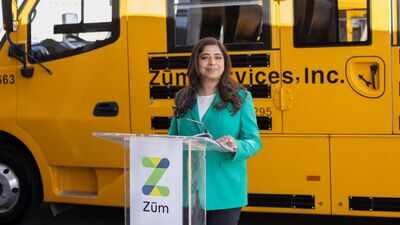
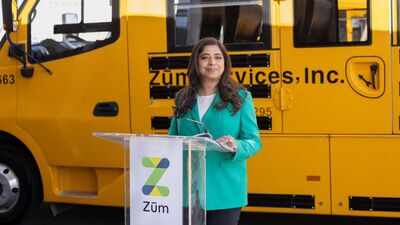
As a parent, getting your children enrolled in schools is only the beginning of a years-long journey that will have its own highs and lows apart from their personal life. From packing their lunches to taking them to the bus stop, all the small things add up big time. But thirteen years ago, while overseeing a billion-dollar line of business at eBay, Ritu Narayan faced one difficulty that she was unable to solve. The digital wizard, did not know how to get her kids, 3 and 8 at the time, to daycare and school, without missing meetings. The private school did not have a bus, Bay Area traffic was terrible, and the part-timers she hired were expensive and inconsistent.She faced a situation in modern America that her mother had faced back during her childhood in the foothills of the Himalayas. “My mom, as an educator in India, had left her job for the same reason,” Narayan said to Forbes. “And I’m here sitting in Silicon Valley at the centre of innovation, and I’m also thinking: Would I have to leave my job, my career?”In the end, Narayan did leave eBay in 2013. Not to become her kids’ chauffeur, but to become an entrepreneur and solve the problem for moms across the states. Along with her two brothers, Vivek and Abhishek Garg, she cofounded Zum, a Redwood City, California-based student transportation outfit that uses technology to improve the student-bus experience.Zum leases bus yards, buys buses and small student shuttle cans and connects them via a tablet and GPS to an app that allows parents and teachers alike to track the vehicles on their routes. Launched in 2015, the startup has grown into a transportation unicorn: with $430 million in funding raised, it is valued at $1.7 billion.In 2025, revenue hit $333 million, up a whopping 35% from 2024 with 5,000 schools nationwide paying for the service. The momentum bumped the 53-year-old CEO onto the 2026 Forbes 50 Over 50 list. Currently, schools in 18 states use Zum’s technology, though Narayan said that it’s just “a matter of time” before she’s in all 50. “Once we are in a district, everybody around wants it. Like when we got the Kansas City [contract], the Omaha Public School District wanted us, and St. Louis, Missouri, wanted us,” she said. “Word spreads very fast.”
Filling the gap
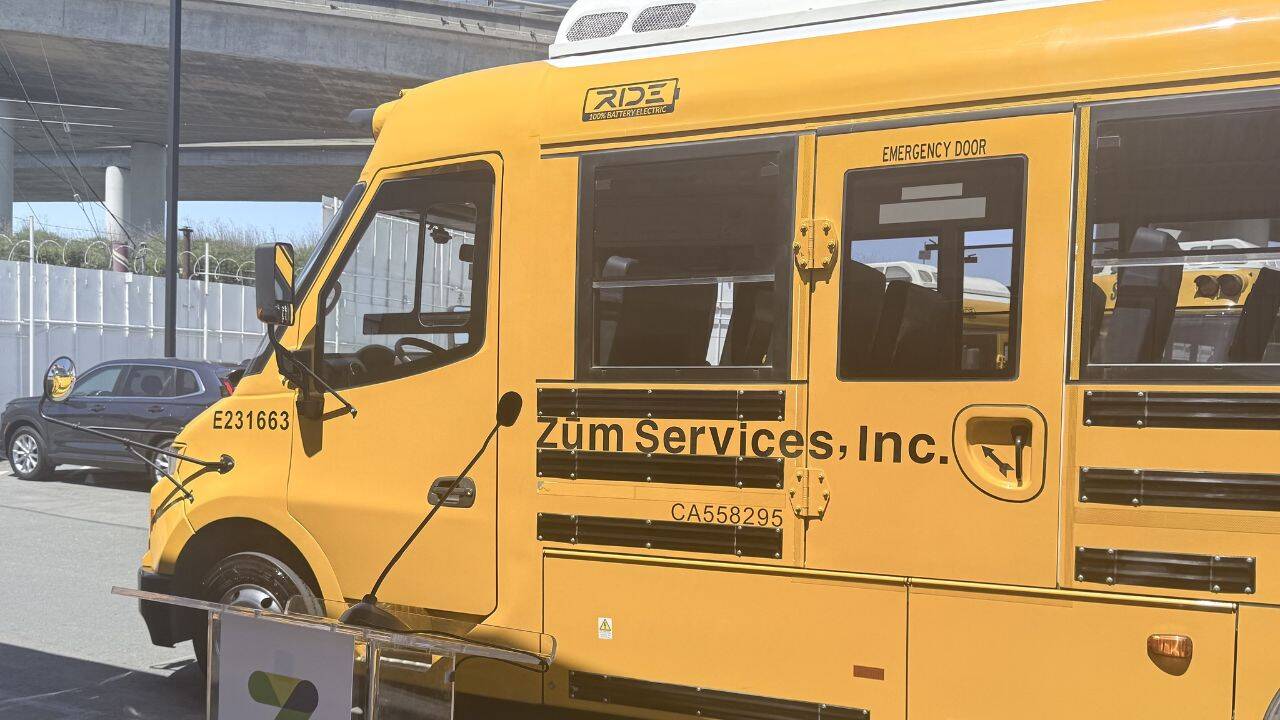
America spends nearly $40 billion a year to get kids to and from school, yet a combination of driver shortages and a patchwork of state-by-state approaches to busing means not all kids actually take a yellow school bus to and from
The growth of Narayan’s startup is a testament to how unorganised the school bus system in the USA currently is. America spends nearly $40 billion a year to get kids to and from school (it’s one of the biggest line items in K-12 education spending), yet a combination of driver shortages and a patchwork of state-by-state approaches to busing means not all kids actually take a yellow school bus to and from elementary, middle or high school. The rest rely on parents, guardians or public transit.“I had no idea how big and complicated this market really was. We’re talking about 26 million kids getting driven to and from school, to and from after-school sports,” said Miriam Rivera, the cofounder and managing director of Ulu Ventures, a Palo Alto, California–based VC shop which was one of Zum’s earliest investors in 2016. “The other thing that surprised me was [that there was a Zum] competitor that at that time had raised over $12 million and delivered 60,000 rides, whereas Zum had raised less than a million dollars and had already delivered about 20,000 rides.”In the company’s earliest days, Narayan called it Liftee; it was basically a ride-sharing service for children, with extra layers of security and safety screening for drivers. She even worked as a Liftee driver herself for a short period (it was, she says, a “nerve-wracking” experience). The model worked well enough among a wealthy demographic in the Bay Area (30 private schools even signed contracts), but ultimately it wasn’t scaling fast enough. When the pandemic closed all in-person schooling in California, it provided a chance to regroup. Narayan reorganised Zum’s business model from a ride-sharing service to a district-wide enterprise platform that can both physically deploy and digitally track a fleet of school buses.“Very quickly we realised that not having your own infrastructure would become a limitation to scaling—plus, the industry is so old, you have to basically transform every single layer,” Narayan says. “You cannot just operate at one layer and think you’ll get the results you’re expecting.”
A successful venture
While Zum checks the basics of a school bus operator: buying and maintaining buses, leasing space to park them and hiring drivers, it also uses AI to analyse existing bus routes to save time, miles and money. A map with moving green, yellow or red dots to mark where the buses are and whether they’re basically on time (green), five to ten minutes behind schedule (yellow) or more than ten minutes late (red).Not just transportation, Zum is also venturing into the energy sector. Electric buses are still two to three times more costly than traditional diesel buses. To meet this challenge, Zum enables the selling of excess capacity in the buses back to the grid, bringing down the cost of electrification. There are half a million school buses on the road, but less than 2% of them are electrified. Recently, Oakland Unified became the first [school] district in the country to be fully electric. The unique thing is that all 74 buses there are bidirectionally charged.Since August 2024, Zum has enabled this ecosystem. “School buses are the ideal assets to be electrified. They have a very predictable local commute pattern. When they are not used for transportation in the evenings, they can be brought back to the yard and plugged back in to give energy back to the grid,” said Narayan to GIC in April 2025. “In just the first five days of going live, we provided 1.9 megawatt (MW) [of] power back to the grid. Our goal is 2.1 gigawatt-hours (GWh) in the entire year, which can power hundreds of homes in Oakland,” she added.Typically, Zum’s contracts are more expensive upfront when compared to traditional bus providers, but its technology reduces the number of buses needed, resulting in cost savings over time for the school district. Narayan said a “fleet-and-route” analysis Zum gave to San Francisco Unified School District (as part of a five-year, $150 million contract it signed in 2021) took the district’s bus numbers from 236 buses to 193, saving $3.5 million a year. “Anytime [SFUSD] had a new need, they would just add one more bus to the road. We went in and optimised the system,” she said.Kimberly Raney, the executive director of transportation at Oakland Unified School District shared how situations were before Zum stepped in. Raney took up her job in 2016, and in those days, nearly everything she did involved telephones and fax machines. When parents needed to change a student’s pickup location, they would fax the new address to the district, which would then fax the information to the school bus vendor. Buses were always running 30 minutes late and it was a telephone chain between drivers, dispatchers, parents and herself to keep everyone updated. “It ran very much like the 1940s and ’50s and ’60s,” she said. Until OUSD signed a five-year, $11.2 million–a-year contract with Zum in 2024, Raney’s fax machines have not screamed.