









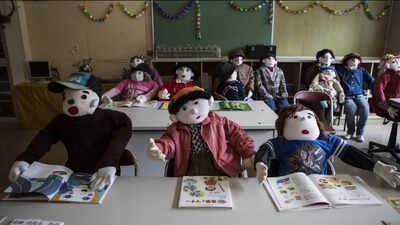
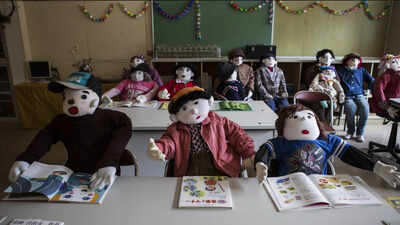
High in the mountains of Shikoku, in Japan’s Tokushima Prefecture, sits Nagoro, a village that once had over 300 residents and now has fewer than 30. What makes Nagoro unusual is not simply its decline, a familiar story across rural Japan, but what one resident chose to do about it. Since the early 2000s, local artist Tsukimi Ayano has handcrafted more than 350 life-size dolls, placing them throughout the village to replace neighbours who have died or moved away. The village’s old elementary school, closed since 2012 after its last two students graduated, now sits filled with doll children at their desks, doll teachers at the chalkboard, a classroom frozen in a version of village life that stopped happening for real years ago.
How one woman began repopulating a shrinking village
According to Miyoshi City’s official tourism site, which now oversees the area since Nagoro falls administratively within Miyoshi City’s remote Higashi-Iya district, Ayano returned to her home village around 2002 after spending most of her adult life in Osaka, moving back to care for her elderly father following her mother’s death. The dolls did not begin as a memorial project. Ayano has said in interviews, including one with NPR, that her first scarecrow was made purely as a practical solution: crows kept digging up the seeds she had freshly planted in her vegetable garden, so she built a scarecrow and dressed it in her father’s old clothes. The resemblance to her father was strong enough that neighbours passing by would mistake it for him and call out a greeting, an exchange Ayano has described fondly, recalling that her father, still very much alive at the time, found the whole mix-up amusing rather than unsettling.What began as a personal tribute grew into something considerably larger. Ayano has said her neighbours would sometimes greet the doll of her father as if he were still alive, telling it good morning as they passed, an experience that seems to have encouraged her to keep making more.
Why Japan’s Nagoro dolls specifically represent people who left or died
Rather than simply decorating the village, Ayano’s dolls function as a kind of running memorial. Each figure is generally modelled on a specific person, either someone who has died or someone who has moved away, and placed in a location tied to that person’s life: farming a field, fishing by the creek, waiting at a bus stop, repairing a road. According to reporting from NBC News, Ayano has made more than 350 dolls in total since she began, though because the dolls themselves eventually wear down and are retired, roughly 150 remained standing in the village at one recent count, still considerably outnumbering the village’s remaining human population.The effect walking through Nagoro is deliberately unsettling in its familiarity, ordinary scenes of rural daily life recreated in careful detail, populated entirely by figures that will never actually move or age the way the people they represent once did.
How the closed village school became the project’s most striking scene
Nagoro’s elementary school closed in 2012 once its final two remaining students graduated, a stark marker of the village’s decline given that it had, within living memory of some residents, supported a much larger student population. Ayano has since filled the empty classroom with doll students seated at desks and a doll teacher positioned at the chalkboard, creating a tableau that references the school’s last living lesson while it sits permanently empty of actual children.Each year, Ayano organises an undokai, a traditional Japanese school sports day, in which child-sized dolls are arranged for races and games alongside real villagers and visitors who take part themselves, briefly filling the village with the kind of noise, food stalls and activity Nagoro’s school once regularly produced before it closed.
Why Nagoro’s story reflects a much larger national pattern
Nagoro’s decline is not an isolated case. According to reporting citing Japan’s National Institute of Population and Social Security Research, Japan’s total population, recorded at roughly 128.06 million in 2010, is projected to fall below 100 million by 2054 at the latest, driven substantially by a persistently low birth rate. The number of children under 15 nationwide had already fallen from around 27 million in the early 1980s to 16.84 million by 2010, a trend that has continued to affect rural areas like Nagoro most severely, as younger residents move to cities for work while older residents remain behind or pass away without replacement.Villages across Japan’s mountainous interior, including much of Shikoku’s Iya Valley region where Nagoro sits, have experienced similar patterns of depopulation and ageing, making Nagoro a particularly visible, and now widely documented, example of a challenge playing out quietly across large parts of rural Japan.
Why Ayano’s project became an unexpected tourist draw
What began as a private, personal response to loss eventually turned Nagoro into a destination in its own right. Following a 2014 short documentary about Ayano’s work by German filmmaker Fritz Schumann, titled Valley of the Dolls, international attention brought a steady stream of visitors to a village that had previously drawn little outside notice. Today, tourists travel specifically to walk among Ayano’s dolls, drawn by a project that manages to be simultaneously an act of personal grief, a form of folk art, and an unusually direct visual record of what rural depopulation actually looks like at the scale of a single, shrinking community.Now in her late sixties and among the youngest residents still living in Nagoro, Ayano has said she intends to keep making dolls for as long as her health allows, continuing a project that, whatever else it has become, started simply as one woman’s way of keeping her father’s presence, and eventually her village’s, from disappearing entirely.