








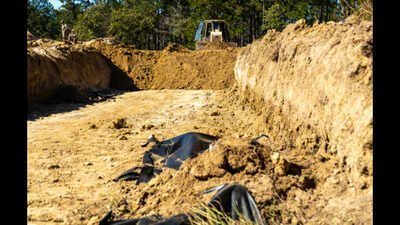
The US Army conducted a rare test practice of digging mass battlefield graves that have not been needed since the Korean War. The Army reported that soldiers in North Carolina completed a “test-of-concept” exercise for large-scale battlefield temporary interment. Soldiers with the 3rd Corps Sustainment Command and the 20th Engineer Brigade, based in Fort Bragg, North Carolina, as well as religious support personnel like military chaplains, used diggers and excavators to see how effectively they could be used to help preserve bodies intact until they could be identified and repatriated to the US.“This exercise allowed us to take a critical look at how we respect, honor, and systematically manage our fallen in a high-intensity conflict,” said Sgt. 1st Class Delbert Ruede, the senior fatality management NCO for the 3rd CSC, in a statement. “If we went to war tomorrow, we would be making this up as we went along. What we are doing here is taking a scientific, field-tested approach so that we can maintain positive control and respectfully care for our fallen.”The core of the exercise, conducted near the St. Mere Eglise Drop Zone, evaluated whether heavy earthmoving equipment could excavate and backfill temporary plots rapidly without causing structural collapse or damage to remains.In theory, a standard temporary interment plot consists of five parallel trenches designed to hold 100 casualties — ten laid on each side of a trench. In previous exploratory trials, units attempted excavation using standard backhoes, averaging three hours per trench for only ten remains. During Dragon Covenant, operators from the 27th Engineer Battalion, 20th Engineer Brigade, utilized D6 bulldozers, completing a full 20-remains trench in an average time of one hour and 15 minutes. During the dig, the team realized they needed to adjust from published spatial standards. Doctrine originally called for a seven-foot corridor between rows, which proved two feet too narrow for a dozer’s tracks to navigate without disturbing the burial area.“We realized quickly that the existing measurements in the book didn’t accommodate the physical reality of the equipment,” Sgt 1st Class Delbert Ruede, the senior fatality management NCO for the 3rd CSC, said. “To prevent running over the remains, we expanded the trench to a 15-foot width and maintained a nine-foot pillar of undisturbed soil between each trench. That undisturbed pillar allows the dozer to drive along the center corridor and cast dirt inward to backfill without exerting direct downward pressure on the remains.”