





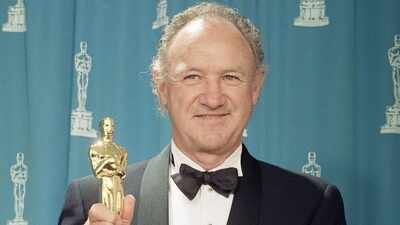
Gene Hackman never wanted to be a movie star. He wanted a paycheck. He wanted to work. He wanted to act, and if acting paid the rent, that was enough. A man who would later win Academy Awards for ‘The French Connection’ and ‘Unforgiven’ was once thrilled by the idea of doubling his weekly pay from $48 to $ 90. For a man with simple goals, Hackman sure has built one of the most celebrated careers in American film historyIn a 1974 interview with The Guardian, he looked back on his early days in New York. He said he only had little goals, and seeing things take a beautiful turn seemed too good to be true.Today’s quote of the day by Gene Hackman reads: “I had only small goals. To go from $48 a week off-Broadway to $90 a week as a supernumerary on Broadway seemed like stealing”
What does the quote by Gene Hackman really mean?
It means to follow your goals one step at a time. Instead of rushing to complete it all in one go, completing small goals one at a time makes the bigger goals not feel like a burden anymore. Hackman explains that at that time, his only focus was to just get a promotion; Hackman wasn’t being modest. He genuinely didn’t think he was special. He was voted “least likely to succeed” at the Pasadena Playhouse alongside his classmate Dustin Hoffman. He was told he wouldn’t amount to anything. He flunked out of acting school. He spent years working odd jobs, doing summer stock, and taking bit parts. So when he finally got to Broadway, even as a supernumerary, essentially a bit player or extra, it felt like a miracle.He says it almost apologetically. He was supposed to go from off-Broadway to a supernumerary role. Instead, he skipped straight into a supporting part. Hackman frames it as if he got lucky, as if he skipped a rung on the ladder and didn’t deserve it. He’s not saying life was easier. He’s saying it was clearer. The goals were small. The wins were tangible. Doubling your pay is a real thing. You can hold it in your hand. It’s harder to feel the weight of an Oscar after a while. But $90 a week when you were making $48. That’s something you remember forever.
How is the quote by Gene Hackman still relevant today?
People are obsessed with big wins, and they skip over the small steps because they don’t feel like steps at all. They feel like standing still. But Hackman’s quote says the opposite. The small goals are the ones that keep you moving.His words also speak to anyone who feels like they’re behind. Hackman didn’t become a leading man until his late thirties. He won his first Oscar at 42. He was broke. He was told he wouldn’t make it. He kept going anyway. Not because he had a grand vision. Because he had small goals.Hackman also never let Hollywood change how he saw himself. “I was trained to be an actor, not a star,” he told Larry King in an interview. “I never had the aspirations to be a star. I wanted to be an actor. A movie actor, a theater actor, that’s all I ever wanted to do”. That’s the same philosophy. The work matters. Not the accolades.
Early life of Gene Hackman
Eugene Allen Hackman was born on January 30, 1930, in San Bernardino, California, to Eugene Ezra Hackman and Anna Lyda Gray. His father operated a newspaper printing press. The family moved around a lot, eventually settling in Danville, Illinois. His childhood wasn’t easy. His father left when Hackman was 13. The memory stayed with him for the rest of his life. Hackman recalled years later. He grew up in a broken home, often in trouble, often fighting with authority figures.He left home at 16. He lied about his age to join the Marine Corps. He spent four and a half years in the service, serving in Japan and China. He was not a model soldier. “I have trouble with direction, because I just have always had trouble with authority,” he told Larry King. “I was not a good Marine. I made corporal once and was promptly busted.”After being discharged, he studied journalism at the University of Illinois on the G.I. Bill. He dropped out. He worked a string of menial jobs. He moved to New York at 22 to try to become an actor. He was over 30 when he finally enrolled at the Pasadena Playhouse. He flunked out after three months. He got one of the lowest grades the school had ever given.
Gene Hackman’s rise to fame
In 1964, he was cast in the Broadway play ‘Any Wednesday’. That led to a small role in ‘Lilith’, starring Warren Beatty. Beatty remembered him. When Beatty was casting ‘Bonnie and Clyde’ in 1967, he cast Hackman as Buck Barrow. That role earned him his first Academy Award nomination for Best Supporting Actor.He was nominated again for ‘I Never Sang for My Father’ in 1970. Then came ‘The French Connection’ in 1971. He played Jimmy “Popeye” Doyle, the tough, New York detective. He won the Oscar for Best Actor. He was 42. He won his second Oscar for ‘Unforgiven’ in 1992. He played Sheriff “Little Bill” Daggett, a sadistic lawman in Clint Eastwood’s revisionist Western. He was 62. He had been working steadily for thirty years. He had done comedy, drama, villainy, and everything in between. He was one of the most versatile actors of his generation.He retired from acting in 2004 after ‘Welcome to Mooseport’. He moved to Santa Fe, New Mexico, with his wife, Betsy Arakawa. He wrote novels. He painted. He lived a quiet life away from Hollywood. He died on February 18, 2025, at the age of 95. He left a philosophy in his wake. Small goals. Small wins. Keep going. And never stop being amazed by how it all turns out.