









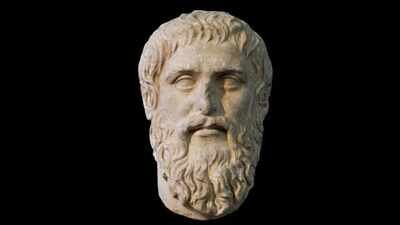
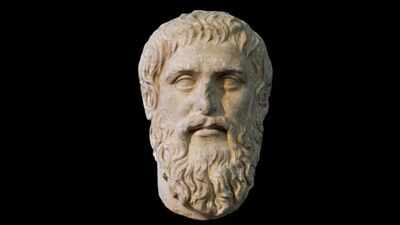
Two people can hit the exact same confusing, unresolved question and respond in completely different ways. One feels the confusion purely as discomfort, something to be resolved as quickly as possible by picking whichever answer sounds most reasonable and then moving on without looking back. The other feels that same confusion as something closer to fascination, a genuine puzzle worth sitting inside rather than rushing past on the way to relief. Plato put this second reaction at the very root of philosophical thinking itself. In the dialogue Theaetetus, written around 369 BC, he has Socrates respond to a young mathematician’s confusion, his dizziness at realizing he can’t fully explain what knowledge actually is, not with reassurance meant to settle the confusion down, but with something closer to approval, telling him that this exact feeling, wonder, is the mark of someone doing philosophy correctly, rather than a sign that something in the conversation has gone wrong.
Quote of the day by Plato:
“Wonder is the feeling of a philosopher, and philosophy begins in wonder.”
Written inside a dialogue about the nature of knowledge itself
What gives this line extra weight is the specific conversation it comes from. Theaetetus is structured as an attempt to define knowledge, and across the dialogue, every proposed definition that Theaetetus offers- knowledge as perception, knowledge as true belief, knowledge as true belief with an account- gets carefully taken apart by Socrates, leaving Theaetetus increasingly disoriented rather than increasingly certain. It’s at that exact point of disorientation, when the ground seems to be giving way under a concept everyone assumes they already understand, that Socrates names wonder as the beginning of the whole enterprise rather than its failure.That framing reflects something central to how Plato understood philosophy’s origins more broadly. His own philosophical life began in the shadow of his teacher Socrates’s trial and execution in 399 BC, an event that left Plato deeply unsettled about the relationship between conventional certainty and actual truth, and that pushed him to found the Academy in Athens, widely regarded as one of the first institutions of higher learning in the Western world, built specifically around the same relentless, unsettled questioning that runs through his dialogues. Wonder, for Plato, was never a symptom to be cured on the way to an answer. It was the entry point into philosophy itself, the state a serious thinker was supposed to return to again and again rather than escape as quickly as possible.
A simple way to actually use this idea
The useful move here is treating confusion about something fundamental as a signal worth paying attention to rather than a problem to be resolved as fast as possible. Modern habits often push in the opposite direction, toward quick answers, tidy explanations, and a general discomfort with sitting inside genuine uncertainty for very long. Plato’s version of philosophy asks for the opposite instinct: when a familiar concept, knowledge, fairness, happiness, suddenly stops making obvious sense under close examination, that disorientation is not evidence the thinking has gone wrong. It’s evidence the thinking has finally reached something worth examining.A fair test, the next time an ordinary assumption suddenly seems less obvious than it did a moment ago, is to ask whether the confusion is worth staying with a little longer rather than being smoothed over immediately. That question won’t resolve every genuine puzzle. It usually keeps a real question from being replaced too quickly by a convenient, half-examined answer.
Other famous quotes by Plato
- “The beginning is the most important part of the work.”
- “Ignorance, the root and stem of all evil.”
- “Human behavior flows from three main sources: desire, emotion, and knowledge.”