









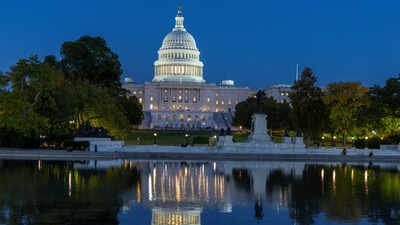

The US midterm elections are nationwide elections held every two years, halfway through a president’s four-year term. This year’s elections will take place on November 3 with voters choosing members of Congress as well as several state and local officials.Unlike presidential elections, midterms do not decide who occupies the White House. Instead, they determine which party controls Congress for the next two years, making them a crucial test of President Donald Trump’s political standing and his ability to push through his agenda.
What are the US midterm elections?
The US Congress has two chambers, the House of Representatives and the Senate, and midterm elections determine the composition of both. All 435 seats in the House are contested every two years, as members serve two-year terms.In the Senate, where members serve six-year terms, roughly one-third of the 100 seats come up for election every two years. This time, 35 Senate seats, including two special-election contests, are at stake. Alongside congressional races, voters in several states will also elect governors and other state and local officials.
What is at stake in the 2026 midterms?
Republicans currently hold narrow majorities in both chambers of Congress.The 435-member House has 218 Republicans, 214 Democrats, one independent who caucuses with Republicans and two vacant seats. A party needs 218 seats for a majority.Meanwhile, the Senate has 53 Republicans and 47 Democrats and allied independents, with 51 seats required for a majority. Democrats need a net gain of four seats in each chamber to take control of both.The outcome could therefore hinge on a small number of closely contested races.
Why do the midterms matter for Trump?
The party controlling Congress has considerable influence over the president’s ability to govern.Congress passes legislation, approves government spending and oversees the executive branch. The Senate also confirms presidential nominees to key government positions, including federal judges and senior administration officials.If Democrats take control of either chamber, they could make it harder for Trump to pass legislation, influence budget negotiations and intensify congressional scrutiny of his administration through hearings and investigations.A Democratic majority in the House could also revive discussions of impeachment, although impeachment by itself would not remove the president from office. Removal requires a two-thirds vote in the Senate.Trump would remain president regardless of the election outcome. He would retain his executive powers and the ability to veto legislation, but a divided Congress could significantly constrain his domestic agenda.
What issues are shaping the vote?
The cost of living, inflation, immigration and the economy are among the major concerns for voters. Foreign policy, including the war involving Iran, is also part of the political debate.Trump’s approval ratings and public perceptions of his administration’s performance are likely to influence the results. Midterm elections are often viewed as a referendum on the sitting president, with the party in the White House frequently losing congressional seats.Disputes over voting rules, election administration and the drawing of congressional district boundaries have also become contentious issues.
When will voting take place and when will results come?
Voting will take place on Tuesday, November 3, across the United States. Polling hours vary by state, and there is no single nationwide closing time.The first polling stations in parts of Indiana and Kentucky are scheduled to close at 6 pm Eastern Time, which is around 4.30 am on November 4 as per Indian Standard Time.Results are expected to emerge through the night, but close contests may take longer to resolve. Election officials must count outstanding ballots, verify results and, where necessary, conduct recounts or deal with legal challenges.News organisations may project winners before every ballot has been counted. Such projections are not official results. State election authorities certify the final results, a process that can take days or weeks.
Where can you check the results?
- US Election Assistance Commission (EAC): A federal agency that provides election information and links to official state election offices.
- USA.gov: The US government’s official portal, which directs users to state websites for election results and voting information.
- Federal Election Commission (FEC): The federal agency responsible for campaign finance oversight. It provides information on federal elections but does not publish live results or certify current election outcomes.
State election offices remain the primary source for official results, including vote counts, recounts and final certification.
What happens if an election result is contested?
A close result can lead to recounts, court challenges and disputes over ballot validity. State officials handle the initial counting and certification process, but the US Constitution gives the House and Senate the power to judge the elections, returns and qualifications of their own members.A candidate or sitting member can challenge a congressional election result. In the House, such disputes are referred to the House Administration Committee, while Senate challenges go to the Senate Rules Committee. The respective chamber ultimately decides whether a member should be seated.This power could become significant if a handful of unresolved races determine which party controls Congress. Any House contests still unresolved when the new Congress convenes in January would be considered by the incoming House.The process can become politically contentious, particularly when party control is at stake. A disputed result may also leave a seat vacant while legal or congressional proceedings continue.