








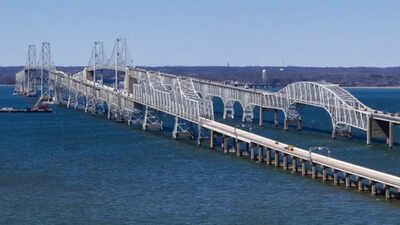
Maryland’s plan to replace the Chesapeake Bay Bridge is raising concerns among farmers and conservation groups on the state’s Eastern Shore. They say the new crossing could increase development pressure on farmland and other open land, and are asking the state to create a dedicated fund to preserve agricultural areas.The Maryland Transportation Authority Board voted in December to move ahead with a plan to build two new four-lane spans across the Chesapeake Bay and remove the existing bridges. WBOC reported. The project would also widen Routes 50 and 301 to eight lanes, with four lanes in each direction. It could also include a shared-use path for cyclists and pedestrians.The new spans would have full shoulders and greater clearance underneath, allowing larger ships to pass through. The project is still several years away, with final design expected to begin in 2028 and construction targeted for 2032.As the plans move forward, the Eastern Shore Land Conservancy is working with local governments and conservation groups on a proposal for a land preservation fund linked to the bridge project. Queen Anne’s, Caroline and Talbot counties have signed a letter supporting the idea.
Development pressure on Eastern Shore
An MTA report on the Bay Crossing project found that more than 111,000 acres across the Eastern Shore are vulnerable to growth and development pressure. The land includes farms, forests and waterways in Caroline, Queen Anne’s and Talbot counties. The three counties together account for about 22% of Maryland’s agricultural sales, according to the report.Jay Falstad, executive director of the Queen Anne’s Conservation Association, said, “The goal is to try and protect farmland for the future,” Falstad said. “Queen Anne’s County is an agricultural gem, and you would not want to see that disrupted with a sea of subdivision development that would follow in the wake of a new Bay bridge.”Falstad said most of the proposed funding would likely go to Queen Anne’s and Caroline counties, which he said are the state’s largest grain-producing counties.“Right now it’s a request of the state basically saying that if you’re going to spend a few billion dollars on a new Bay bridge, then you ought to be prepared to allocate a few hundred million dollars for land preservation,” Falstad said.He also said agriculture is Queen Anne’s County’s top economic sector and that the county has preserved nearly 40% of its farmland. Falstad remains opposed to the bridge project, saying the state has not adequately justified the need for a new span given the remaining lifespan of the existing bridge.
Conservation group proposes land fund
Carol Bean, land use and policy manager for the Eastern Shore Land Conservancy, said the preservation fund is still only a concept. No formal agreement is in place, and discussions are continuing with the Maryland Department of Transportation and other state agencies.Bean said the group is trying to align its work with the formal record of decision for the bridge project, which she said could come as early as this fall or early winter.“The state has made the decision. They’ve picked a route. They’re moving ahead with it,” Bean said. “So in our perspective, it’s how do you do that in the most responsible way that respects the kind of tradition and economy of the Eastern Shore. And land preservation is a really key way that you can do that. It’s a way you can protect the investment in the bridge as well.”Bean said development along the corridor could also affect the bridge’s purpose of easing traffic. “If you don’t protect that corridor, you end up with more development, which means more access points,” she said. “You can use land preservation as a strategic tool to protect that investment, but also to fundamentally support these key industries of the Eastern Shore, like agriculture.”
Caroline County watches development
Travis Breeding, president of the Caroline County Board of Commissioners, said the county wants to protect its rural character as development pressure grows.“The rural heritage of Caroline County is very important to us, and we want to preserve that,” Breeding said. “The additional expansion of the Bay bridge could increase development here in Caroline County, and we really want to slow that down.”Breeding said the proposed fund remains a concept. The request is for the Maryland Department of Transportation and the Transportation Authority to establish a funding stream to preserve agricultural land in the Mid-Shore region.
Farmers want a say
Stephen Kraszewski, a Queen Anne’s County farmer whose family runs Mason Farms Produce on a fifth-generation farm, said farming is closely tied to the region’s rural way of life. He said Queen Anne’s County has more corn and soybean farmland than any other county in Maryland.“It feels like there’s a target on our back,” Kraszewski said, noting that the bridge route runs through Kent Island and directly through the county on the way to beach destinations including Ocean City, Rehoboth and Lewes. “Those farmers, they want to see their way of life preserved, just not taken over. Not bulldozed. Not removed.”Kraszewski said losing farmland could affect the wider farming community. “If losing farmland means you lose a farmer, you lose some of the heritage that’s already here,” he said. “We are a community. We try to work with each other. We talk to each other. We solve problems together. And one less farmer is a real blow to our community.”He said he is not against growth but wants farmers to have a role in decisions about development. “We want structured expansion, with everybody’s input, not just simple meetings that record people saying what they want, and then they’re tossed aside,” he said. “We want a voice, and we want to have our input in how it all works out .We want to make sure people have healthy food to eat and local food. That’s probably the most important thing that you can have for anybody who enjoys those three meals a day is local, healthy produce. And yeah, you have to have land to grow that,” Kraszewski added.