








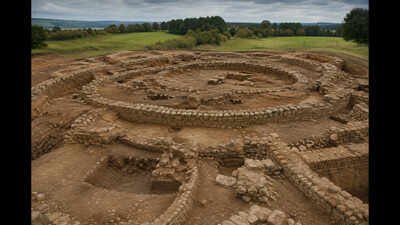
An unusual Iron Age fort hidden in the former wetlands of Shropshire is being excavated again after almost four decades, giving archaeologists a rare opportunity to investigate one of Britain’s most enigmatic lowland forts. Wall Camp, near Kynnersley and Telford, has been selected as the new home of the University of Birmingham’s Archaeology Field School under a 10-year research partnership. More than 60 students joined academics for the first three-week excavation in June 2026, opening three trenches across the Scheduled Monument. The project is examining the fort’s banks, ditches, entrance and unusual internal layout, including causeways that appear to lead nowhere. The University of Birmingham, which announced the excavation on 23 July, says the site is among the largest and best-preserved examples of a low-lying “marsh fort” in Britain.
Why is Wall Camp such an unusual Iron Age fort?
Wall Camp stands in an unexpected setting for an Iron Age fort. Rather than occupying a prominent hilltop, it was constructed on a slightly raised island within the Weald Moors, an area that was once characterised by boggy woodland and wetlands. The fort is surrounded by as many as five concentric earthworks, creating an imposing and complex defensive landscape across the low-lying terrain. The University of Birmingham describes it as one of Britain’s largest and best-preserved examples of a marsh fort, a comparatively rare type of monument. The monument covers roughly 12 hectares and has long challenged straightforward interpretations. Earlier archaeological work established Iron Age occupation, but questions remain over why such substantial earthworks were constructed in a wetland environment. Historic England’s Heritage Gateway records Wall Camp as a large, complex Iron Age defended settlement that originally stood on an island in fenland.
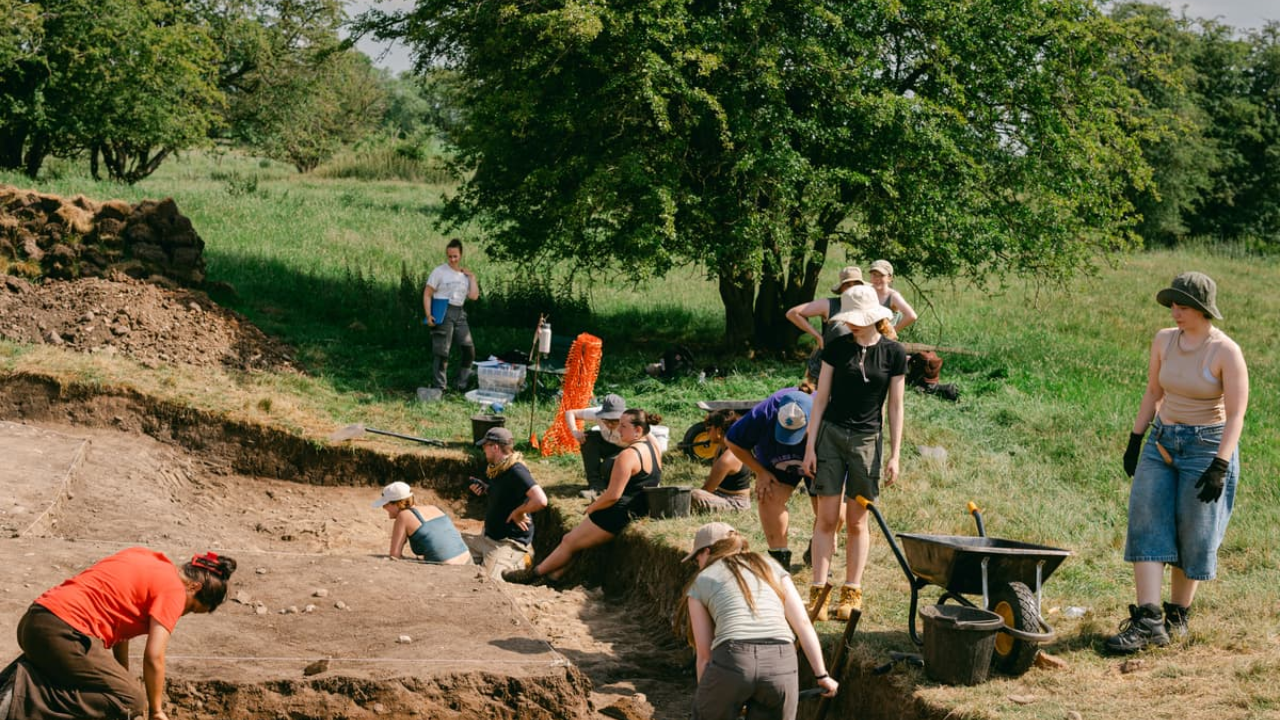
What are archaeologists looking for in the new Wall Camp excavation? (Image: University of Birmingham)
What are archaeologists looking for in the new Wall Camp excavation ?
The first modern campaign is designed to answer some of the most basic questions about how Wall Camp functioned. The team opened three trenches during a three-week excavation, focusing on the site’s layout, architecture, banks, ditches and elaborate entranceway. Researchers are particularly interested in understanding how people moved into and out of the fort and why its unusual features were positioned where they are. Among the most puzzling features are several causeways that appear to lead nowhere. Their purpose remains uncertain, and the excavation could establish whether they were practical routes, carefully designed approaches or structures connected with activities beyond conventional settlement. The project is being led by Dr Theo Reeves, Professor Henry Chapman and Dr David Smith, with Historic England involved in the wider research.“The site is a fascinating Iron Age fort with many intriguing features, and it will be wonderful to examine them up close,” says Professor Henry Chapman. The University also says the 10-year partnership will allow successive student cohorts to combine archaeological training with continuing investigation of the monument.
What has already been discovered at Wall Camp?
Although the latest excavation marks the first major return to Wall Camp in about 40 years, archaeologists already know that the site contains evidence of substantial Iron Age activity. Earlier excavations uncovered roundhouses and pottery associated with regional salt-trading networks. A particularly striking discovery was a rare blue glass bead established as an example of exceptional craftsmanship. These finds indicate that Wall Camp was connected to wider networks rather than being an isolated monument. The site has also produced evidence that complicates its interpretation. Archaeological records show Iron Age pottery and structures within the fort, while radiocarbon and artefactual evidence places occupation broadly between the third century BC and the first century AD. The surrounding wetland may have been equally important. Earlier research has considered possibilities ranging from settlement and pastoral activity to high-status, refuge or ritual functions, reflecting how little is still known about the monument’s precise role.
Will the new excavation finally solve Wall Camp’s Iron Age mystery?
The latest excavation is only the first stage of a much larger investigation into Wall Camp. According to the University of Birmingham, the new field school forms part of a 10-year research collaboration that will allow archaeologists to return to the site repeatedly and build a much fuller picture of how the fort developed and was used. The June 2026 excavation focused on understanding its layout, entrance, banks, ditches and unusual access features, particularly causeways that appear to lead nowhere. Researchers now want to establish when Wall Camp was constructed, why such enormous earthworks were built and what purpose the surrounding wetlands served. The answers could reveal whether the marshland was simply a defensive advantage or played a deeper economic, social or ceremonial role. Historic England notes that the ditches and buried surfaces may preserve waterlogged organic material capable of revealing changes in the local environment and land use. The excavation could therefore do more than uncover artefacts, it may ultimately explain why this unusual Iron Age monument was built in such an extraordinary landscape.